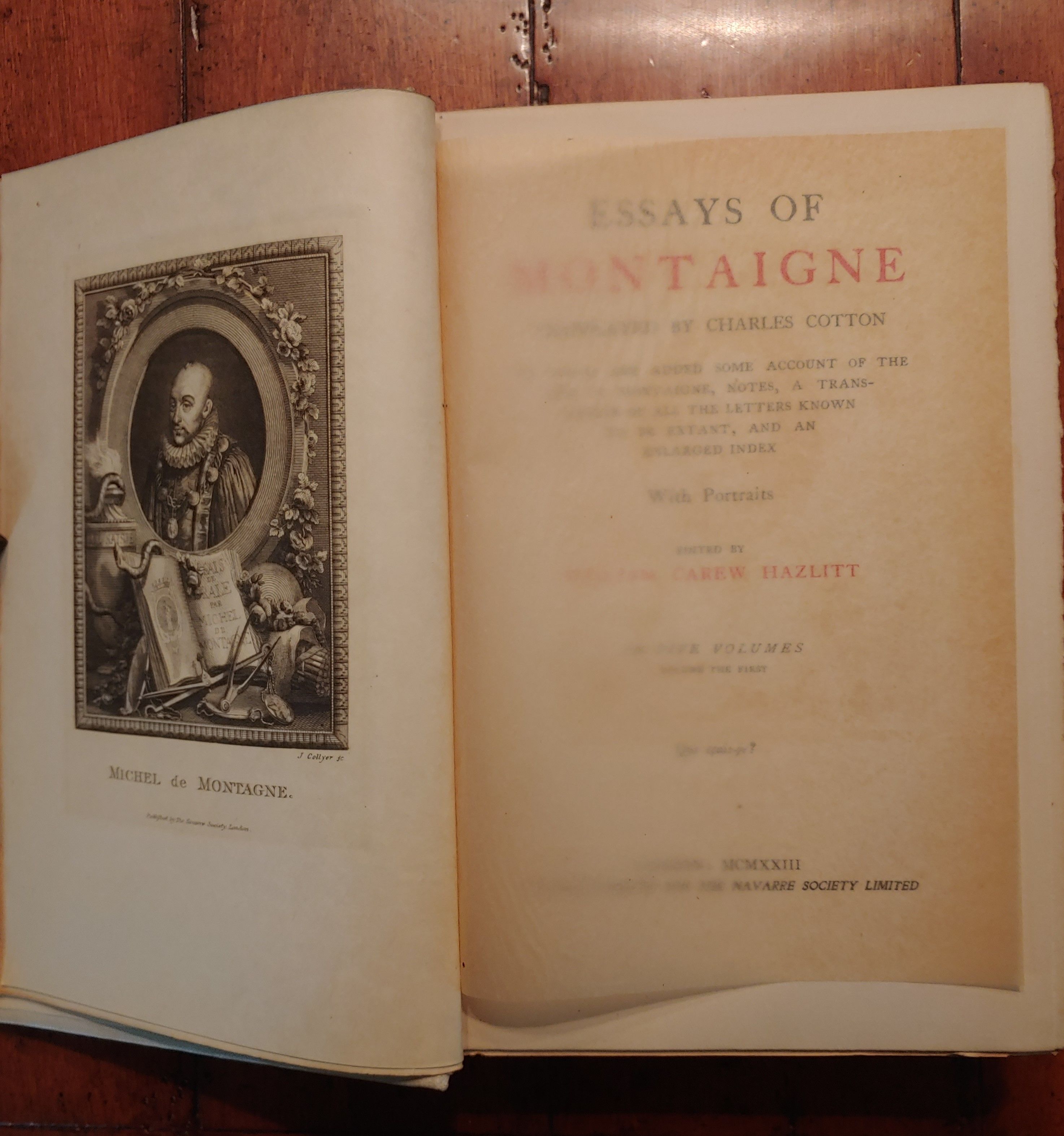
Essays, Book I Michel de Montaigne 1. We reach the same end by different means they could carry. They, with greatness of heart, carried out on their shoulders their husbands, their children and the Duke himself. The Emperor took such pleasure at seeing their lovely courage that he Jul 18, · The Essays of Montaigne () by Michel de Montaigne, edited by William Carew Hazlitt, translated by Charles Cotton. First published in ; from the edition revised and edited in by William Carew Hazlitt. Michel de Montaigne The Essays of Montaigne Montaigne's Essays II. Of Drunkennesse III. A Custome of the Ile of Cea IV. To-morrow is a New Day V. Of Conscience VI. Of Exercise or Practice VII. Of the Recompenses or Rewards of Honour VIII. Of the Affections of Fathers to their Children: To the Lady of Estissac IX. Of the Parthians Armes X. Of Bookes XI. Of Crueltie XII. An Apologie of Raymond Sebond XIII
The Essays of Montaigne - Wikisource, the free online library
PREFACE THE LETTERS OF MONTAIGNE I. BOOK THE FIRST — CHAPTER I — THAT MEN BY VARIOUS WAYS ARRIVE AT THE SAME END. The present publication is intended to supply a recognised deficiency in our literature—a library edition of the Essays of Montaigne.
This great French writer deserves to be regarded as a classic, not only in the land of his birth, essays of montaigne, but in all countries and in all literatures. But, at the same time, estimating the value and rank of the essayist, we are not to leave out of the account the drawbacks and the circumstances of the period: the imperfect state of education, the comparative scarcity of books, and the limited opportunities of intellectual intercourse.
Montaigne freely borrowed of others, and he has found men willing to borrow of him as freely. We need not wonder at the reputation which he with seeming facility achieved. Essays of montaigne was, without being aware of it, the leader of a new school in letters and morals. His book was different from all others which were at essays of montaigne date in the world.
It diverted the ancient currents of thought into new channels, essays of montaigne. Above all, the essayist uncased himself, and made his intellectual and physical organism public property. He took the world into his confidence on all subjects. Of all egotists, Montaigne, if not the greatest, was the most fascinating, because, perhaps, he was the least affected and most truthful. What he did, and what he had professed to do, was to dissect his mind, and show us, as best he could, how it was made, and what relation it bore to external objects.
He investigated his mental structure as a schoolboy pulls his watch to pieces, to examine the mechanism of the works; and the result, accompanied by illustrations abounding with originality and force, he delivered to his fellow-men in a book.
Eloquence, rhetorical effect, poetry, were alike remote from his design, essays of montaigne. He did not write from necessity, scarcely perhaps for fame. But he desired to leave France, nay, and the world, something to be remembered by, something which should tell what kind of a man he was—what he felt, thought, suffered—and he succeeded immeasurably, I apprehend, beyond his expectations.
It was reasonable enough that Montaigne should expect for his work a certain share of celebrity in Gascony, and even, as time went on, throughout France; but it is scarcely probable that he foresaw how his renown was to become world-wide; how he was to occupy an almost unique position as a man of letters and a moralist; how the Essays would be read, in all the principal languages of Europe, by millions of intelligent human beings, who never heard of Perigord or the League, and essays of montaigne are in doubt, if they are questioned, whether the author lived in the sixteenth or the eighteenth century.
This is true fame. A man of genius belongs to no period and no country. He speaks the language of nature, essays of montaigne, which is always everywhere the same. In the earliest impression the errors of the press are corrected merely as far as page of the first volume, and all the editions follow one another. That of was the only one which the translator lived to see. He died essays of montaigneleaving behind him an interesting and little-known collection of poems, which appeared posthumously, 8vo, A Life of the Author and all his recovered Letters, sixteen in number, have also been given; but, as regards the correspondence, it can scarcely be doubted that it is in a purely fragmentary state.
Nor is redundancy or paraphrase the only form of transgression in Cotton, for there are places essays of montaigne his author which he thought proper to omit, and it is hardly necessary to say that the restoration of all such matter to the text was considered essential to its integrity and completeness. By the favour of Mr F, essays of montaigne. It has his autograph and copious MSS.
notes, nor is it too much to presume that it is the very book employed by him in his translation. Michel de Montaigne. His father, essays of montaigne, Pierre Eyquem, esquire, was successively first Jurat of the town of Bordeauxessays of montaigne, Under-MayorJurat for the second time inProcureur inand at length Mayor from to a mighty good faith in his speech, and a conscience and a religious feeling inclining to superstition, essays of montaigne, rather than to the other extreme.
To associate closely his son Michel with the people, and attach him to those who stand in need of assistance, he caused him to be held at the font by persons of meanest position; subsequently he put him out to nurse with a poor villager, and then, at a later period, made him accustom himself to the most common sort of living, taking care, nevertheless, to cultivate his mind, and superintend its development without the exercise of undue rigour or constraint. Michel, who gives us the minutest account of his earliest years, charmingly narrates how they used to awake him by the sound of some agreeable music, and how he learned Latin, without suffering the rod or shedding a tear, before beginning French, thanks to the German teacher whom his father had placed near him, essays of montaigne, and who never addressed him except in the language of Virgil and Cicero.
The study essays of montaigne Greek took precedence. At six years of age young Montaigne went to the College of Guienne at Bordeaux, where he had as preceptors the most eminent scholars of the sixteenth century, Nicolas Grouchy, Guerente, Muret, and Buchanan. Essays of montaigne thirteen he had passed through all the classes, and as he was destined for the law he essays of montaigne school to study that science. He was then about fourteen, but these early years of his life are involved in obscurity.
The next information that we have is that in he received the appointment of councillor in the Parliament of Bordeaux; in he was at Bar-le-Duc with the court of Francis II, and in the year following he was present at Rouen to witness the declaration essays of montaigne the majority of Charles IX. We do not know in what manner he was engaged on these essays of montaigne. Between and an important incident occurred in the life of Montaigne, in the commencement of his romantic friendship with Etienne de la Boetie, whom he had met, as he tells us, by pure chance at some festive celebration in the town.
From their very first interview the two found themselves drawn irresistibly close to one another, and during six years this alliance was foremost in the heart of Montaigne, as it was afterwards in his memory, when death had severed it.
Although he blames severely in his own book [Essays, i. The history of his early married life vies in obscurity with that of his youth. His biographers are not agreed among themselves; and in the same degree that he lays open to our view all that concerns his secret thoughts, the innermost mechanism of his mind, he observes too much reticence in respect to his public functions and conduct, essays of montaigne, and his social relations.
The title of Gentleman in Ordinary to the King, which he assumes, in a preface, and which Henry II. gives him in a letter, essays of montaigne, which we print a little farther on; what he says as to the commotions of courts, where he passed a portion of his life; the Instructions which he wrote under the dictation of Catherine de Medici for King Charles IX.
Michael, essays of montaigne, which was, as he essays of montaigne us himself, the highest honour of the French noblesse. According to Lacroix du Maine, Montaigne, upon the death of his eldest brother, resigned essays of montaigne post of Councillor, in order to adopt the military profession, while, if we might credit the President Bouhier, essays of montaigne, he never discharged any functions connected with arms.
However, several passages in the Essays seem to indicate that he not only took service, but that he was actually in numerous campaigns with the Catholic armies.
Let us add, that on his monument he is represented in a coat of mail, with his casque and gauntlets on his right side, and a lion at his feet, all which signifies, in the language of funeral emblems, that the departed essays of montaigne been engaged essays of montaigne some important military transactions. in his thirty-eighth year, on the eve of the Calends of March, his birthday, Michel Montaigne, already weary of court employments and public honours, withdrew himself entirely into the converse of the learned virgins where he intends to spend the remaining moiety of the to allotted to him in tranquil seclusion.
At the time to which we have come, Montaigne was unknown to the world of letters, except as a translator and editor. We may suppose that he began to compose the Essays at the very outset of his retirement from public engagements; for as, according to his own account, observes the President Bouhier, he cared neither for the chase, nor building, nor gardening, nor agricultural pursuits, and was exclusively occupied with reading and reflection, he devoted himself with satisfaction to the task of setting down his thoughts just as they occurred to him.
Those thoughts became a book, and the first part of that book, which was to confer immortality on the writer, appeared at Bordeaux in Montaigne was then fifty-seven; he had suffered essays of montaigne some years past from renal colic and gravel; and it was with the necessity of distraction from his pain, and the hope of deriving relief from the waters, that he undertook at this time a great journey. As the account which he has left of his travels in Germany and Italy comprises some highly interesting particulars of his life and personal history, it seems worth while to furnish a sketch or analysis of it, essays of montaigne.
we must go as far, as Basle, of which we have a description, acquainting us with its physical and political condition at that period, as well as with the character of its baths.
The passage of Montaigne through Switzerland is not without interest, as we see there how our philosophical traveller accommodated himself everywhere to the ways of the country. The hotels, the provisions, the Swiss cookery, everything, was agreeable to him; it appears, indeed, as if he preferred to the French manners and tastes those of the places he was visiting, and of which the simplicity and freedom or frankness accorded more with his own mode of life and thinking.
In the towns where he stayed, Montaigne took care to see the Protestant divines, to make himself conversant with all their dogmas.
He even had disputations with them occasionally. He then passed through Brunsol, Trent, where he put up at the Rose; thence going to Rovera; and here he first lamented the scarcity of crawfish, but made up for the loss by partaking of truffles cooked in oil and vinegar; oranges, essays of montaigne, citrons, and olives, in all of which he delighted.
After passing a restless night, when he essays of montaigne himself in the morning that there was some new town or district to be seen, essays of montaigne, he rose, we are told, with alacrity and pleasure. His secretary, to whom he dictated his Journal, assures us that he never saw him take so much interest in surrounding scenes and persons, essays of montaigne, and believes that the complete change helped to mitigate his sufferings in concentrating his attention on other points.
When there was a complaint made that he had led his party out of the beaten route, and then returned very near the spot from which they started, his answer was that he had no settled course, and that he merely proposed to himself to pay visits to places which he had not essays of montaigne, and so long as they could not convict him of traversing the same path twice, essays of montaigne, or revisiting a point already seen, he could perceive no harm in his plan.
As to Rome, he cared less to go there, inasmuch as everybody went there; and he said that he never had a lacquey who could not tell him all about Florence or Ferrara. He also would say that he seemed to himself like those who are reading some pleasant story or some fine book, of which they fear to come to the end: he felt so much pleasure in travelling that he dreaded the moment of arrival at the place where they were to stop for the night.
We see that Montaigne travelled, just as he wrote, completely at his ease, and without the least constraint, turning, essays of montaigne, just as he fancied, from the common or ordinary roads taken by tourists.
The good inns, the soft beds, the fine views, attracted his notice essays of montaigne every point, and in his observations on men and things he confines himself chiefly to the practical side. The consideration of his health was constantly before him, and it was in consequence of this that, while at Venice, which disappointed him, he took occasion to note, for the benefit of readers, that he had an attack of colic, and that he evacuated two large stones after supper.
He pronounced the Florentine women the finest in the world, but had not an equally good opinion of the food, which was less plentiful than in Germany, and not so well served. He lets us understand that in Italy they send up dishes without dressing, but in Germany they were much better seasoned, and served with a variety of sauces and gravies.
He remarked further, that the glasses were singularly small and the wines insipid. After dining with the Grand-Duke of Florence, Montaigne passed rapidly over the intermediate country, which had no fascination for him, and arrived at Rome on the last day of November, entering by the Porta del Popolo, and putting up at Bear. But he afterwards hired, at twenty crowns a month, fine furnished essays of montaigne in the house of a Spaniard, who included in these terms the use of the kitchen fire.
What essays of montaigne annoyed him in the Eternal City was the number of Frenchmen he met, who all saluted him in his native tongue; but otherwise he was very comfortable, and his stay extended to five months. The world, jealous of her, prolonged empire, had in the first place broken to pieces that admirable body, and then, when they perceived that the remains attracted worship and awe, had buried the very wreck itself.
Again, he was apprehensive, seeing the space which this grave occupied, that the whole might not have been recovered, and that the burial itself had been buried. And, moreover, to see a wretched heap of rubbish, as pieces of tile and pottery, grow as it had ages since to a height equal to that of Mount Gurson,—[In Perigord. He Montaigne observed that it was difficult to believe considering the limited area taken up by any of her seven hills and particularly the two most favoured ones, the Capitoline and the Palatine, that so many buildings stood on the site.
He believed that an ancient Roman would not recognise the place again. It often happened that in digging down into earth the workmen came upon the crown of some lofty column, which, though thus buried, was still standing upright.
The people there have no recourse to other foundations than the vaults and arches of the old houses, upon which, as on slabs of rock, they raise their modern palaces. It is easy to see that several of the ancient streets are thirty feet below those at present in use.
Sceptical as Montaigne shows himself in his books, yet during his sojourn at Rome he manifested a great regard for religion. He solicited the honour of being admitted to kiss the feet of the Holy Father, Gregory XIII. He saw a Jewish child circumcised, essays of montaigne, and wrote down a most minute account of the operation.
He met at San Sisto a Muscovite ambassador, essays of montaigne, the second who had come to Rome since the pontificate of Paul III. The court of Muscovy had at that time such limited relations with the other powers of Europe, and it was so imperfect in its information, that it thought Venice to be a dependency of the Holy See.
I begged him, on the contrary, to abide by the opinion of the person who had criticised me, confessing, among other matters, as, for example, in my use of the word fortune, in quoting historical poets, essays of montaigne, in my apology for Julian, essays of montaigne, in my animadversion on the theory that he who prayed ought to be exempt from vicious inclinations for the time being; item, in my estimate of cruelty, as something beyond simple death; item, essays of montaigne, in my view that a child ought to be brought up to do everything, and so on; that these were my opinions, which I did not think wrong; as to other things, I said that the corrector understood not my meaning.
The Master, who is a clever man, essays of montaigne, made many excuses for me, and gave me essays of montaigne suppose that he did not concur in the suggested improvements; and pleaded very ingeniously for me in my presence against another also an Italian who opposed my sentiments. Such is what passed between Montaigne and these two personages at that time; but when the Essayist was leaving, and went to bid them farewell, they used very different language to him.
To essays of montaigne themselves for what they had said against my book, they instanced works of our time by cardinals and other divines of excellent repute which had been blamed for similar faults, which in no way affected reputation of the author, or of the publication as a whole; they requested me to lend the Church the support of my eloquence this was their fair speechand to make longer stay in the place, where I should be free from all essays of montaigne intrusion on their part.
It seemed to me that we parted very good friends. Before quitting Rome, Montaigne received his diploma of citizenship, by which he was greatly flattered; and after a visit to Tivoli he set out for Loretto, stopping at Ancona, Fano, and Urbino, essays of montaigne. He arrived at the beginning of Mayat Bagno della Villa, where he established himself, order to try the waters.
There, we find in the Journal, of his own accord the Essayist lived in the strictest conformity with the regime, essays of montaigne henceforth we only hear of diet, the effect which the waters had by degrees upon system, of the manner in which he took them; in a word, he does not omit an item of the circumstances connected with his daily routine, his habit of body, his baths, and the rest.
PHILOSOPHY - Montaigne
, time: 6:03Essays of Michel de Montaigne

Essays, Book I Michel de Montaigne 1. We reach the same end by different means they could carry. They, with greatness of heart, carried out on their shoulders their husbands, their children and the Duke himself. The Emperor took such pleasure at seeing their lovely courage that he Jul 18, · The Essays of Montaigne () by Michel de Montaigne, edited by William Carew Hazlitt, translated by Charles Cotton. First published in ; from the edition revised and edited in by William Carew Hazlitt. Michel de Montaigne The Essays of Montaigne Montaigne's Essays II. Of Drunkennesse III. A Custome of the Ile of Cea IV. To-morrow is a New Day V. Of Conscience VI. Of Exercise or Practice VII. Of the Recompenses or Rewards of Honour VIII. Of the Affections of Fathers to their Children: To the Lady of Estissac IX. Of the Parthians Armes X. Of Bookes XI. Of Crueltie XII. An Apologie of Raymond Sebond XIII

No comments:
Post a Comment